The Word Random Does Not Explain the Whole Game
Random in casino games describes uncertainty, not the whole experience. See how rules, choices and presentation shape what a player can understand.
What does “random” actually tell you about a casino game? Usually, it tells you that an outcome is uncertain; it does not explain how the game produces that outcome, what choices a player has, or how the rules make the result legible. To understand a particular game, separate the unpredictable event from the structure around it.
Random describes uncertainty, not the whole game
In everyday speech, “random” can mean surprising, arbitrary or impossible to predict. In a game, it is more useful to use the word narrowly: an outcome is random when chance helps determine which result occurs. A shuffled deck, a roulette wheel’s stopping point and a slot machine’s displayed combination all involve outcomes the player cannot know in advance.
That label leaves many questions unanswered. It does not tell you what outcomes are possible, how they are selected, how a result is resolved or what a player can do before it appears. Those details belong to the game’s rules and design.
Imagine a player at a table where a card is drawn from a shuffled deck. The next card is uncertain, but the game’s rules still specify which cards count as a win, when the draw happens and whether the player can make a choice first. Randomness describes one part of the event; the rules give it meaning.
This distinction matters because a game can be unpredictable without feeling confusing, and a game can be easy to predict while still having unclear rules. Chance and clarity are separate qualities.
Rules turn outcomes into meaningful results
A random result becomes a game result only through a rule that interprets it. The same card can mean different things in different games. A red card might settle a wager in one setting, contribute to a hand in another or have no special effect at all.
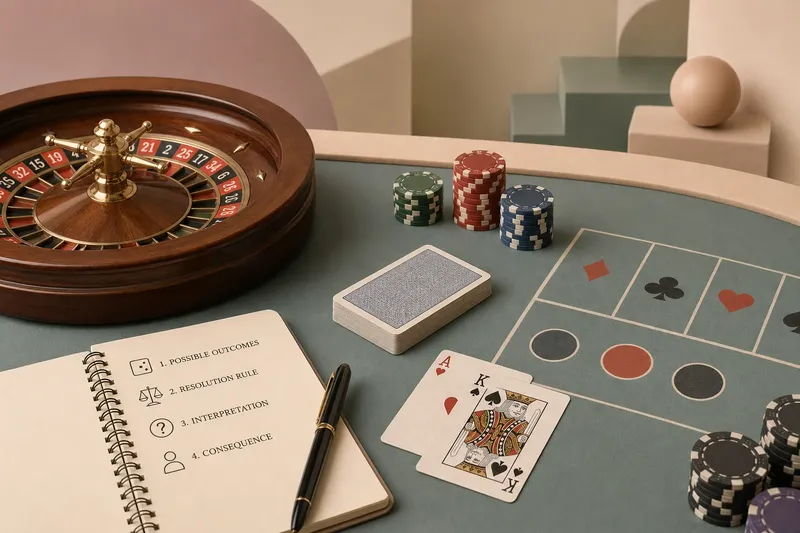
To explain a chance-based game clearly, identify the link between outcome and consequence:
- Possible outcomes: What can appear or happen?
- Resolution rule: How does the game settle the event?
- Interpretation: Which result counts as a win, loss, tie or other outcome?
- Consequence: What changes for the player after that result?
These questions expose gaps that the word random can hide. Saying “the wheel is random” does not tell a newcomer how a bet is settled. Saying that the wheel stops on a marked space and that the mark determines the result is more informative, though the available bets and their rules still need explaining.
Designers also decide which outcomes to include and how to present them. A deck’s composition, a wheel’s numbered spaces and a machine’s symbols are all part of the game’s structure. Chance may choose among those possibilities, but it does not create the rules that define them.
Player choices can coexist with chance
Randomness does not mean that a player has no decisions. A game may let someone choose a bet, select an action or decide whether to continue before an uncertain result occurs. The choice shapes the situation, while chance helps determine what happens next.
It is useful to ask what a choice can affect. It might change which outcomes count, how much is at stake, or whether another event takes place. It might also have no effect on the underlying random process. Those are different design relationships, and players should not have to guess which one applies.
Say you are looking at a fictional table game with two available bets. One bet is settled by a card’s colour; the other is settled by its suit. You choose the colour bet, then the dealer draws from a shuffled deck. The draw remains uncertain, but your decision selected the condition that will determine how the result is interpreted. That choice does not let you control the card.
This distinction helps keep explanations honest. “You choose your bet” describes agency. “The result is random” describes uncertainty. Neither statement cancels the other, and neither tells the whole story alone.
Randomness does not mean every outcome is equally likely
People often hear “random” and assume that every possible result has the same chance of appearing. That is not what the word means by itself. A random process can select among outcomes with different likelihoods, depending on the mechanism and the game’s design.
For instance, a bag containing several kinds of tokens could produce a random draw even if one kind appears more often than another. The selection is uncertain, but the set-up affects how likely each result is. In a game, the relevant details might include which cards are in play, how a wheel is arranged, or how the rules handle repeated events.
For a player, the practical question is not simply “Is it random?” It is also “What outcomes are possible, and what affects their likelihood?” A clear explanation should answer those questions when they matter to understanding a decision. If the game does not disclose enough for a player to interpret an outcome, calling it random does not fill in the missing information.
Chance can also operate at different points. It may determine a result directly, or it may shape a later choice by revealing information first. A card drawn face up, for example, creates a visible event that can affect what players know. The draw is uncertain beforehand; once revealed, its role in the game depends on the rules.
Presentation shapes how chance feels
Two games can use chance yet communicate it differently. A visible roulette wheel gives players a clear physical event to watch. A card draw makes the selected object visible after it is revealed. A digital game may show symbols, animations or a result screen. These presentations affect what players notice, but they do not replace the rules that settle the game.
Designers choose how much of the process to show. A player may see the whole draw, see only its final outcome, or receive an explanation of how the result was determined. Each approach can make the experience feel more or less transparent. A dramatic animation may make an outcome feel momentous, but it does not establish why that outcome occurred or what it means.
Language matters here, too. “The game picked a winner” may sound as though the software made a deliberate choice. “The result was selected by the game’s random process and interpreted under its rules” is less vivid but separates mechanism from consequence. A concise explanation can be plain without implying that chance has intentions.
What is not worth the effort is treating every surprising outcome as evidence of a hidden pattern. A player can notice sequences, but a sequence alone does not explain the process that produced it. For understanding the game, start with its stated outcomes and rules rather than trying to read intention into a run of results.
Questions that clarify what random means?
Does random mean the game has no rules?
No. Randomness concerns uncertainty in an outcome, while rules define how the game creates, recognises and resolves that outcome. A game can rely heavily on chance and still have precise rules.
Can a random result be predictable?
A player may know what outcomes are possible or that some are more likely, without knowing which one will occur on a particular occasion. Predicting a range or likelihood is not the same as knowing the next result.
Does a player’s choice make the result less random?
Not necessarily. A choice can determine which condition or wager applies while chance still determines the event itself. The rules should make clear what the choice changes.
What should a game explanation say instead of “it is random”?
It should name the uncertain event, describe the possible outcomes and explain how each outcome affects play. If player choices or different likelihoods matter, those details should be stated too.
Explain the mechanism and the meaning separately
A useful explanation of a chance-based game can follow a simple order: name the event that is uncertain, identify what can happen, state how the game resolves the event, then explain how the result affects the player. Add the player’s available choices and any relevant differences in likelihood. This gives a reader a working picture without pretending that “random” answers every question.
When a rule is unclear, ask which part is missing. Is the uncertain event not described? Are possible outcomes unclear? Does the player not know what the result changes? Separating those problems makes the explanation easier to repair than repeating the same label.
The word random is useful when it names uncertainty precisely. It becomes a shortcut when it is asked to stand in for the mechanism, the rules and the player’s choices. In a casino game, understanding chance starts with knowing what is left undecided—and what the design has already decided for you.