A Quiet Tabletop Sorting Session for Learning Game Terms
A tabletop sorting session for learning game terms helps you group unfamiliar words, write plain definitions and spot what needs a rulebook check.
Which game terms should you learn first, and how can you sort them without turning the evening into a practice game? A tabletop sorting session for learning game terms gives you a quiet way to group unfamiliar words, write provisional definitions and see where a rulebook needs to do the explaining.
All you need is blank paper, a pen and a source of terms: a rule sheet, glossary, card text or game box. Keep the activity separate from play. You are organising vocabulary, not simulating a hand, betting or testing what a rule does.
Choose the sorting style that fits your situation
Start with the kind of confusion you actually have. A tidy alphabetised list can look useful while leaving related ideas scattered, so sort by meaning or by the question a term raises.
- You are new to a game’s vocabulary: Make a broad group for words you recognise and another for words you cannot explain yet. This gives you a manageable starting point without requiring prior knowledge.
- You know the words but mix up their roles: Sort terms by what they describe, such as a component, an action, a result or a condition. This is useful when two words sound similar but refer to different parts of a game.
- You are reading a dense rule sheet: Group terms by where they appear: setup, a turn, scoring, exceptions or reference text. This helps you locate the passage that defines a word in context.
- You are sharing the activity with someone else: Let each person sort a small set independently, then compare the groups. Differences reveal which terms need a clearer definition, without requiring either person to act out a rule.
For a first session, choose one of these approaches rather than combining them all. You can reorganise the slips later if the first grouping exposes a better question.
Make slips that preserve the source of each term
Write one unfamiliar term on each slip. Add the game’s name or a short source note on the back, especially if you are collecting words from more than one rulebook. A term can have a specific meaning in one game and a looser everyday meaning elsewhere.
Use the exact spelling and capitalisation shown in the source. If a phrase appears as a named rule, keep its words together; splitting it into separate slips may hide the fact that the phrase has one defined meaning.
Leave room for a plain-language definition on the reverse. If you do not know what a term means, write a question instead of guessing. “When does this apply?” or “What does this refer to?” is more useful than a confident but unsupported explanation.
Group terms by the question they answer
Lay the slips face up and make a few loose piles. These categories work well for many tabletop and casino games, but treat them as prompts, not as official classifications:
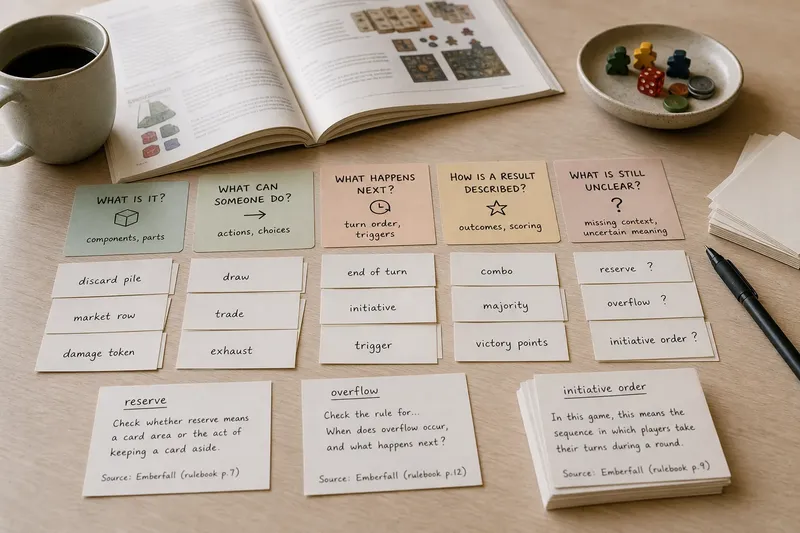
- What is it? Components, spaces, cards, tokens or other named parts.
- What can someone do? Actions, choices, exchanges or restrictions.
- What happens next? Turn order, transitions, triggers or end conditions.
- How is a result described? Outcomes, combinations, ranks or scoring language.
- What is still unclear? Terms with missing context, competing meanings or a definition you cannot locate.
Do not force every slip into a neat pile. Place a term between two groups if it seems to serve both purposes, and mark it with a small question mark. That position is a prompt to check how the rulebook uses it, not evidence that the term belongs in either category.
Write definitions that explain use, not just synonyms
A useful definition tells you what the term refers to in this particular game. Replacing an unfamiliar word with another unfamiliar word rarely helps, and an everyday synonym may erase a distinction the rules depend on.
Try this simple format on the back of a slip: “In this game, this means…” Then add a short phrase based on the source. If the source does not define the term directly, write “Check the rule for…” followed by the unresolved question.
Say you are sorting terms from an invented card game and find reserve on a card. You cannot tell whether it names a pile or a choice, so you place the slip in “What is still unclear?” and write, “Check whether reserve means a card area or the act of keeping a card aside.” The visible result is a focused question to look for in the glossary or rule text; no one needs to play a turn to discover it.
When you find the definition, add the relevant context in your own words and keep the source note. If the wording remains ambiguous, preserve the uncertainty rather than turning an interpretation into a rule.
Use these questions when a term refuses to settle?
Should I look up every unfamiliar word?
Look up terms that affect how a rule is read, especially named actions, outcomes and exceptions. If a word is descriptive and does not change the meaning of the passage, mark it for later rather than interrupting the whole session.
What if the same term appears in two games?
Keep separate slips or add the game name to each one. Compare the definitions only after recording them in context, since shared wording does not mean the rules use the term identically.
How many terms should I sort at once?
Use a handful if the activity is meant to feel light, or take a larger set if you already have a glossary to work through. Stop when the piles begin to blur together; the aim is to make relationships visible, not to clear a whole rulebook.
Should I settle a disputed definition by agreement?
Record each interpretation and check the official wording or a clearly labelled reference section. If the source leaves the meaning open, keep the disagreement noted rather than treating a group vote as an official ruling.
Choose a stopping point that leaves useful notes
End when you have a few coherent groups, a short list of unresolved questions and definitions that point back to their source. Put uncertain slips together, separate from terms you can explain, so a later reading session can begin with the questions that matter most.
It is not worth decorating the slips, inventing elaborate category names or debating every borderline case. Those tasks can make the exercise feel busy without making the vocabulary clearer.
A tabletop sorting session for learning game terms works best as a small reference-making task: collect words, group them by the job they do, and leave honest notes where meaning is still uncertain. Keep the slips with the relevant rule sheet, and they can help you return to the game’s language without pretending that vocabulary work is the same as learning to play.