The Turn as a Small Machine: What a Game Sequence Organizes
A clear game turn sequence separates setup, action and resolution, helping players see when decisions count and what the rules do next.
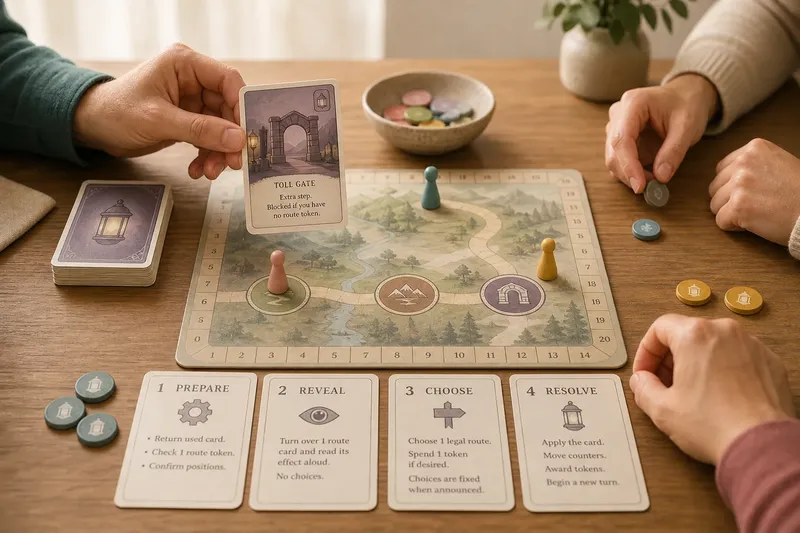
Where does a decision end and its result begin? A clear game turn sequence answers that question before a player has to guess. In a casino-style game, the order of a turn can separate preparation, choice and settlement so that everyone at the table can follow what is open, what is fixed and what happens next.
Consider an invented game called Lantern Run. It uses a small board, numbered cards and counters, but its useful design lesson is not tied to those props. The turn works like a small machine: each phase accepts certain inputs, changes the state of play and passes a legible situation to the next phase.
Lantern Run begins with an unclear turn
Imagine three players seated at a table. Each has a counter on a track, and a shared deck supplies a card each round. The written rule says: “Take a card, choose a move, then settle the round.” It sounds compact, but it leaves several questions hanging.
Does a player choose a move before seeing the card? Can the card change a choice already made? When does a player spend a token? Does “settle” mean moving counters, paying out, or both? The rules give verbs, but not boundaries. Players may still reach a result, yet they have to negotiate the procedure as they go.
That negotiation creates avoidable friction. One player may treat a choice as final as soon as it is spoken; another may assume it remains open until all players have acted. If a card is revealed in between, the disagreement is not really about strategy. It is about the shape of the turn.
The designer’s task is not simply to add more instructions. It is to decide which actions belong together, what information is available in each group and what signal tells players that a group has ended.
A phase boundary makes the game turn sequence legible
Lantern Run is revised into four named phases: prepare, reveal, choose and resolve. The names are plain enough to remember, and each phase has a distinct job.
- Prepare: return the previous round’s used card to the discard pile, check that each player has one route token, and confirm that all counters are on the spaces shown by the current board state.
- Reveal: turn over one route card and read its effect aloud. No player chooses a move during this phase.
- Choose: each player selects one legal route and, if desired, spends a route token to alter that choice. Choices are made in turn order and become fixed when announced.
- Resolve: apply the revealed card, move counters according to the fixed choices and award any tokens the rules specify. Then begin a fresh turn.
The phase labels do more than divide a paragraph. They tell players what kind of action is available and what information they may use. During reveal, the card is public, but no move is yet committed. During choose, the card is known and a token can still affect the announced route. During resolve, choices are no longer being made; the table is carrying out the agreed procedure.
Each boundary also carries a small handover. Reveal passes the card to choose. Choose passes fixed routes to resolve. Resolve passes an updated board state to prepare. If a rule does not fit neatly into one phase, that is a prompt to check the design: perhaps the action needs a new phase, or perhaps its timing should be stated more precisely.
The invented round shows what the sequence changes
Say the board has three route spaces: a short path, a switchback and a toll gate. A player begins the round at the switchback with one route token. The revealed card says that the toll gate gives an extra step but blocks a player who has no token.
During prepare, the player checks the token and position. The player has the token, so all three routes are legal. During reveal, the card’s effect becomes public. The player can now compare the routes with the same information as everyone else.
During choose, the player announces the toll gate and spends the token to protect that route from the card’s blocking effect. The choice is fixed at the announcement. During resolve, the table applies the card, confirms the protection, moves the counter and awards the route’s extra step if the written rules allow it. The result is visible on the board, and the next turn starts from that state.
The sequence makes the decision’s timing observable. The player did not have to choose in the dark, and no one has to infer whether the token was spent before or after the card took effect. The phases also make a dispute easier to locate: if players disagree about whether the token protects the route, the question belongs to the resolve rule, not to the choice procedure.
This is the practical value of a case-style walk-through. It follows one decision from the state before it, through the moment of commitment, to the changed state after it. A rulebook can use the same pattern: show what the player knows, what they may do, when the choice closes and how the outcome is applied.
Keep setup, action and resolution distinct
Most turns benefit from a distinction between three broad jobs, even if the game uses different names. Setup establishes the conditions for a decision. Action lets a player make that decision. Resolution applies its consequences.
Setup may include checking resources, refreshing a shared supply or revealing information. Action may include selecting a route, placing a wager or choosing a target, depending on the game. Resolution may move pieces, settle a result or update a public track. These are design categories, not universal rules; a game can combine or omit them when its play remains clear.
The important test is whether a player can tell which job is happening now. If players may still alter a choice while the result is being applied, the boundary is weak. If a player needs information that arrives only after the choice closes, the sequence may be withholding essential context. And if setup changes a resource, say whether that change happens before or after the player’s options are checked.
When a game uses simultaneous choices, the action phase can still be distinct. Players might select in private, then reveal together. The rule should identify when choices are locked and whether a player may revise a selection before the reveal. The reveal itself is not necessarily resolution: the game may still need to compare choices and apply their effects afterward.
What should happen when a phase gets interrupted?
Can players change a choice after announcing it?
State the point at which a choice becomes fixed. If revisions are allowed, specify the window and the information players may use before it closes.
Should every game have the same number of phases?
No. Use only the divisions that make the game easier to operate. A short game may need one combined setup-and-reveal phase, while a game with hidden choices may need a separate commitment and reveal.
What belongs in the resolution phase?
Put the procedures that turn fixed choices and known effects into an updated game state. If players make a fresh strategic choice during that process, it may belong in a later action phase instead.
How can a rule signal that a phase has ended?
Use a clear trigger, such as each player announcing a route or the active player turning over a marker. A signal should mark the boundary without adding a separate action players must remember for its own sake.
Write the sequence around decisions, not decorative labels
A phase name is helpful only if its rules match its purpose. “Planning” is a poor label if players cannot actually plan until a hidden card is revealed. “Settlement” is too broad if it contains both a new choice and several automatic effects. Prefer a concrete name that tells the reader what to do, then put the relevant procedure directly underneath it.
For each phase, a designer can check a few practical questions:
- What is the game state when this phase begins?
- What information is public, private or newly revealed?
- Which actions are legal now, and which are not?
- What event closes the phase?
- What state or information passes to the next phase?
These questions are useful during drafting because they expose missing handovers. They also help keep rules in one place. If token spending is allowed during choose, the rule should not reappear in resolve as if the player may spend again. Resolve can instead say how a previously spent token affects the outcome.
It is not worth giving every tiny rule its own named phase. A separate label for each minor effect can make a turn feel like paperwork and make the actual decision harder to see. Split a phase when players need a different kind of information, a different set of legal actions or a clear commitment point—not merely because the rules have another sentence.
Use the sequence to teach the game at the table
When introducing Lantern Run, a host can teach one turn in the same order the rules use: check the starting state, reveal the card, make and lock choices, then apply the result. The players can see the phases happen rather than trying to hold an abstract procedure in memory.
A compact reference card can repeat the phase names and the one action that defines each. It should not replace a rule that explains an edge case, but it gives players a quick cue when they lose their place. Matching wording matters: if the rules say “resolve” and the card says “score”, players may wonder whether those refer to one phase or two.
For a game turn sequence to do its job, the player should be able to answer three questions at every boundary: what has already happened, what may happen now and what will close this moment. In Lantern Run, those answers make a route choice readable from the first reveal to the counter’s final position. The same check is useful whenever a rule feels disputed: find the phase where the decision becomes fixed, then make its boundary unmistakable.