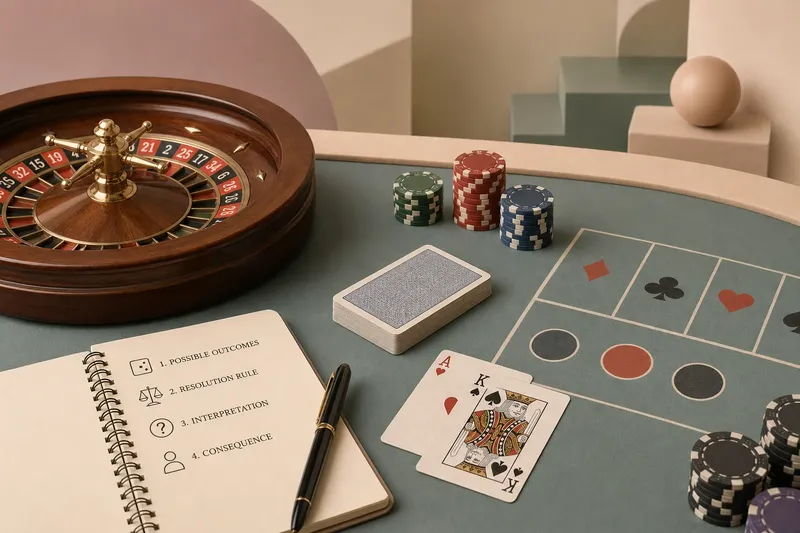
From Painted Cards to Printed Components: A Brief Material History of Casino Games
See how painted cards, wood, paper and modern printed components changed casino games’ handling and recognition without changing their rules.
How did casino games move from hand-painted cards to recognisable printed components, and what changed at the table? The material history of casino games is a history of making pieces easier to produce, handle and identify—not a story of new materials rewriting the rules.
Follow the components in the order a player encounters them: first the card, then the marks that distinguish it, then the chips and table objects that make play easier to manage. This approach keeps the focus on physical design rather than on the history of particular rules.
Start with the card as a made object
Early playing cards were produced by hand. In parts of Europe, makers painted or drew designs on card stock, so each pack demanded skilled work. Handmade production allowed variation in appearance, but making consistent packs took time. The cards’ material and finish also affected how they felt in the hand and how readily they could be shuffled.
Paper-making and printing changed the scale and repeatability of production. Printed designs could be reproduced across a pack, making suits and ranks more consistent from card to card. The shift did not create the underlying card-game rules. It changed the means of producing the objects those rules used.
As you look at a historical pack, separate three questions: what is the card made from, how was its face applied, and how was it finished for handling? These distinctions matter because “printed” does not describe one fixed object. Paper quality, coatings, surface texture and cutting all influence how a pack feels, even when its symbols are familiar.
Notice how repeatable marks support recognition
Printed suits and ranks let makers place the same identifying marks in predictable positions. A player could recognise a card by its central design or by a small index near a corner. Corner indices are especially useful in crowded hands: a narrow strip remains visible while much of the card is covered.
That is a change in access and visibility, not in what a card represents. The rank and suit still carry their assigned meanings. Printing makes those meanings easier to display consistently and recognise at a glance.
When comparing designs, look at contrast, symbol shape and placement. A dark spade against a light ground is easy to distinguish from a red diamond; a decorative flourish may be handsome but can complicate quick recognition. Ask what a player can see while holding several cards, not merely what looks clear when one card lies flat.
Follow the move from paper to table objects
Casino play uses more than cards. Chips, markers, dice, plaques and table layouts give players and staff objects to handle, identify and arrange. Their materials have varied: wood, bone, clay, metal, paper and later moulded plastics have all served different purposes in gaming contexts. A material’s value lies not only in appearance but in whether the object can be distinguished, moved and kept in usable condition.
Chips show how recognition can be designed into a component. Colour, edge markings, inlays and shape help distinguish one piece from another. These features support handling and visual sorting; they do not, by themselves, define the rules governing a wager. A table’s layout performs a related visual task by giving objects designated places.
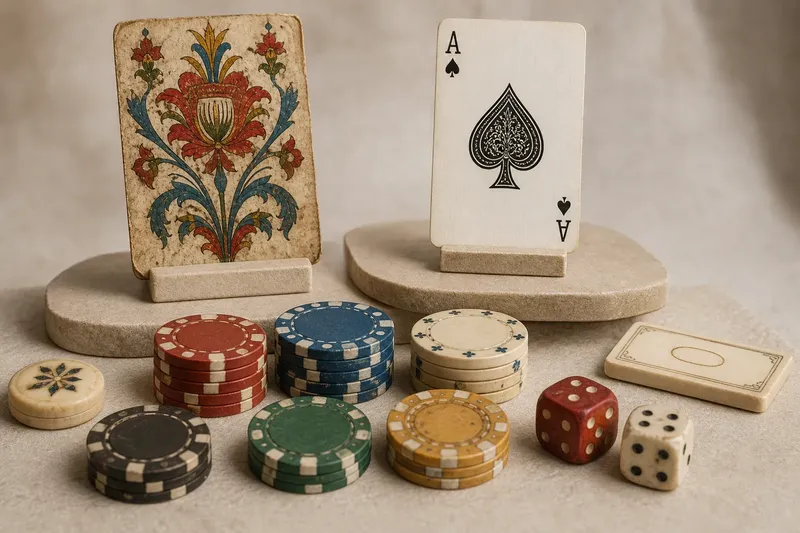
Imagine a small historical display containing a hand-painted card, a printed card with corner indices and a set of differently marked chips. Place each on a separate neutral stand, then note what is easiest to identify from across the display and what is easiest to inspect up close. The expected observable result is that some features aid distant recognition while others become clear only when the object is near. This makes material and graphic choices visible without pretending the display represents a real game or a tested comparison.
Compare handling as well as appearance
Materials shape the physical actions a component permits. A card needs enough flexibility to bend slightly, yet enough structure to keep its form through ordinary handling. A chip needs a shape that can be picked up and placed with control. A die needs faces that can be recognised after it comes to rest. These are practical demands, not claims that one material is universally best.
Surface finish matters too. A slick card may slide readily; a rougher surface may offer more grip. A printed mark can be crisp or blurred, and a worn edge can make a component harder to distinguish. When examining an object, note where the wear appears: corners, edges, printed areas or the surface most often touched. That evidence can suggest how the object was handled, though it cannot establish the exact rules played with it.
Not every material detail is worth the effort. If your purpose is to understand how components became easier to produce and recognise, you do not need to catalogue every pigment, coating or manufacturing variation. Keep details that explain handling, repeatability or visibility; leave specialist production questions aside unless they directly affect that account.
Read a component without reading new rules into it
A historical component can tempt you to infer a whole game from its appearance. Resist that leap. A deck with familiar suits may have been used in different games across places and periods. A chip’s markings may identify it within a particular setting, but the object alone does not tell you every procedure attached to it.
Use a simple sequence when examining an object:
- Identify the material. Describe what is visible, such as paper, wood, metal or a moulded substance, without claiming more than the object supports.
- Describe the marking. Note whether the design is painted, printed, stamped, engraved or applied in another visible way.
- Check recognition cues. Look for colour, shape, symbols, indices and repeated placement.
- Consider handling. Observe flexibility, weight, edge shape and surface texture where these can be assessed safely.
- Separate object from rule. Record what the component makes easier to see or do, then leave game procedures to evidence that actually describes them.
This order keeps an account grounded. It lets you explain the practical effect of a material change without claiming that a new surface or printing method caused a change in play itself.
Questions readers ask about casino game materials?
Did printed cards change the rules of card games?
Printing changed how cards could be made and how consistently their marks appeared. It did not, on its own, alter the rules assigned to ranks, suits or turns.
Why do many cards have corner indices?
Corner indices let a player identify rank and suit while holding a fan of cards, when most of each card face is covered. They are a visibility feature rather than a new game mechanic.
What were casino chips made from?
Gaming pieces have been made from varied materials, including clay, metal and moulded substances, with designs that can include colour, edge details and inlays. The material and markings depend on the object and its context.
Can a component reveal which game was played?
It can offer clues, but a component alone rarely explains a complete ruleset. Identify the object’s visible features first, then look for reliable context before drawing conclusions about its use.
Use material history to make a careful comparison
When you compare two components, choose one practical question: which is easier to recognise, which appears more consistent, or which seems designed for repeated handling? Describe the visible evidence, then state the limit of what it can tell you. This is more useful than calling one object simply “modern” and another “primitive”.
The material history of casino games is clearest when each shift is tied to a specific task. Hand production gave way to methods that could reproduce marks more consistently; indices made identification possible when cards were partly concealed; chips and table objects gave play tangible pieces to sort and move. The rules may remain the same while the objects become easier to make, handle and recognise. That distinction is the most useful thing to carry from one old component to the next.